
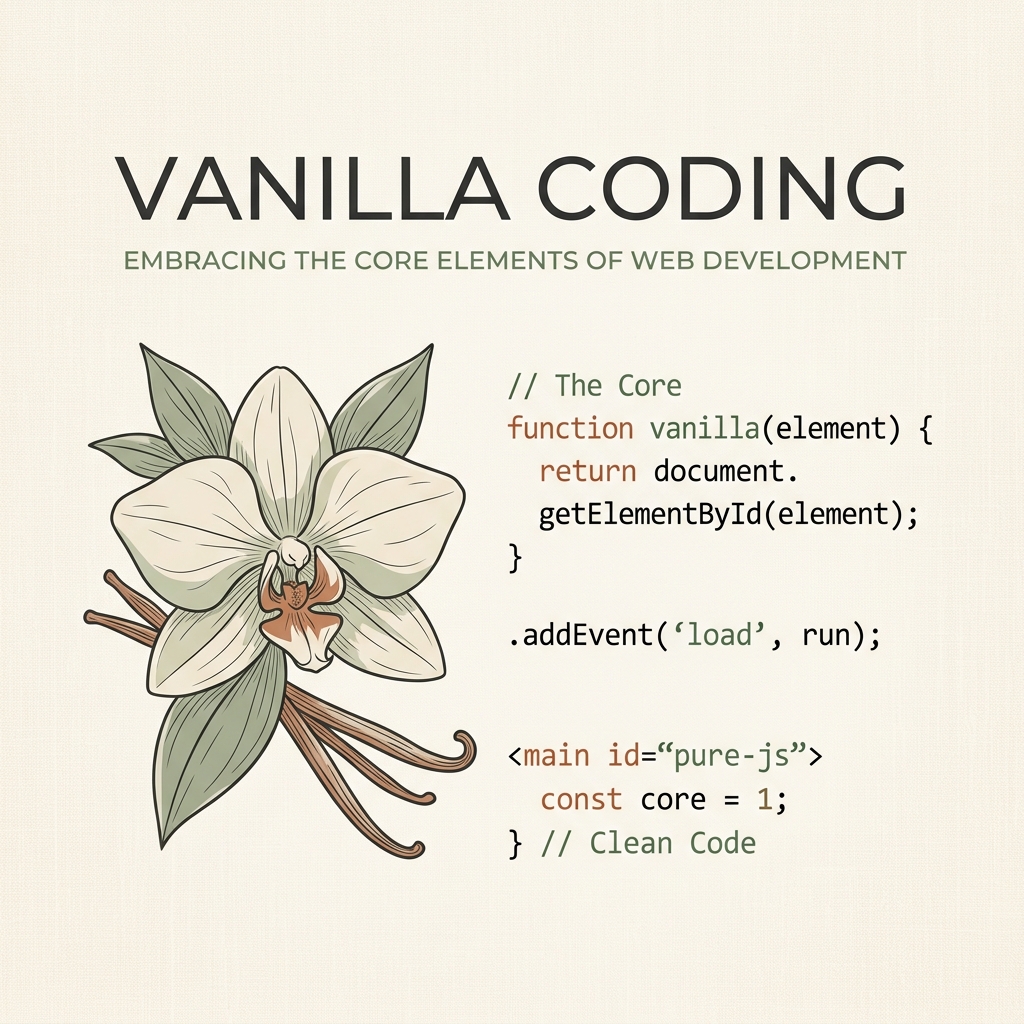
In an era dominated by heavy frameworks, nested dependencies, and complex build steps, a quiet revolution is happening. Developers are rediscovering the joy, speed, and elegance of Vanilla Coding—writing plain, standard HTML, CSS, and JavaScript.
While frameworks like React, Vue, and Angular have their place in massive, team-driven enterprise environments, they often introduce substantial overhead for content sites, portfolios, and blogs.
Here is why embracing the "Vanilla" way is the ultimate superpower for modern web developers.
1. Zero Dependency Bloat (Unmatched Performance)
Every framework comes with a tax. This includes the library runtime itself, its helper libraries, state management solutions, and the compiler utilities.
When you write vanilla code:
- No Hydration Delay: Your HTML is immediately parseable and interactive the moment it lands in the user's browser.
- Microscopic Bundle Sizes: Your CSS and JS are only as large as the rules and functions you actually write.
- Better Core Web Vitals: Search engines love speed. Vanilla sites consistently score perfect 100s on lighthouse metrics.
2. Standard Web APIs Are Now Incredible
Many developers learned web development during the era of browser fragmentation, when libraries like jQuery were required to write consistent cross-browser code. Today, the web platform has matured:
- DOM Selection: Querying elements is a breeze with
document.querySelectorandquerySelectorAll. - Styling: Modern CSS custom properties (variables), Grid, and Flexbox make frameworks like Tailwind or Bootstrap optional.
- State & Interactivity: Standard Web Components and native custom events allow you to encapsulate logic without framework compilation.
For example, look at the pure-CSS lightbox gallery on this very website. It achieves interactive image overlay effects using the native CSS :target selector, with zero JavaScript.
3. Future-Proofing Your Codebase
Frameworks evolve rapidly. What was best-practice in React or Next.js three years ago is deprecated today. Upgrading dependencies is a constant chore that risks breaking your site.
Vanilla code is permanent. Standard HTML, CSS, and JS written in 2016 still runs perfectly today in 2026, and will continue to run perfectly in 2036. The browser vendors prioritize backward compatibility above all else.
4. Direct Control and Debugging
When something breaks in a framework, you often have to dig through stack traces of minified runtime code or search GitHub issues. When a vanilla page has an issue, it's always your code, making debugging fast, transparent, and educational.
Conclusion: The "Vanilla Gorilla" Strategy
Our static generator, Vanilla Gorilla, is built on this exact philosophy. It compiles templates and Markdown files into raw, static HTML pages. It lets you write clean, vanilla code while automating the repetitive parts (scaffolding, RSS generation, and sitemaps).
The next time you start a project, ask yourself: Do I need a framework, or do I just need the web? You might be surprised at how far vanilla coding can take you.